


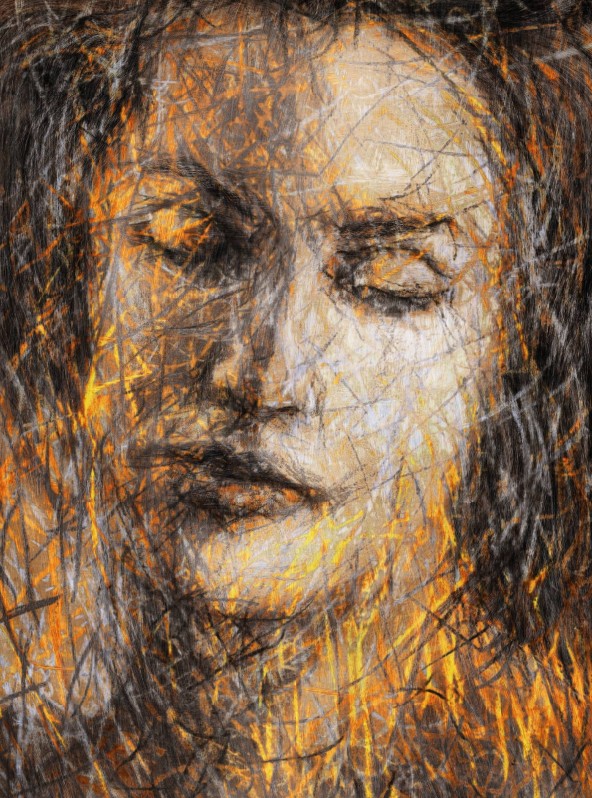
The Lord Jesus Christ inspired love and devotion in many people with whom he came into contact. Perhaps no one more deeply than Mary Magdalene. We know very little about her, except for glimpses of her selfless loyalty during his ministry, her courage and dedication in the fraught and dangerous events surrounding his crucifixion, and the fact that she was given the enormous privilege of being the first disciple to meet him after his resurrection.
She appears in the record around half way through Christ’s three and a half year ministry. ‘He went on through cities and villages, proclaiming and bringing the good news of the kingdom of God. And the twelve were with him, and also some women who had been healed of evil spirits and infirmities: Mary, called Magdalene, from whom seven demons had gone out, and Joanna, the wife of Chuza, Herod’s household manager, and Susanna, and many others, who provided for them out of their means’ (Luke 8:1–3).
Feeding and supporting the Lord and his 12 apostles, and presumably others at various times as they toured the country, would have presented a considerable logistical challenge. It was met by a group of faithful women who accompanied them, and provided for them ‘out of their means’. Only a few of these are mentioned by name. Mary is usually mentioned first—this might imply that she was the leader and coordinator of the group, or that she was especially close to the Lord.
Mary was a common Jewish name at the time. it’s the Greek form of the Hebrew name Miriam—Miriam the prophetess was Moses’ sister. There are a number of Marys in the Gospel records, and so this one is identified as Magdalene—probably because she was from Magdala, a town on the coast of the Sea of Galilee.
It’s interesting to note that those women who are picked out by name had each been healed of some disease. Theirs was more than an intellectual discipleship—they were driven both by conviction and by gratitude. And of Mary we’re told that ‘seven demons had gone out’.
Demon Possession
Demons are associated with intense suffering, when we see them in the New Testament. Sufferers might be handicapped (Matthew 12:22), wracked with convulsions (Matthew 17:15), or driven mad (Mark 5:1–5). Nowadays we recognise that what the Greek world in the First Century called ‘demon possession’ are generally symptoms of severe mental illnesses.
Evidently Mary had been horribly afflicted. Jesus had restored her to her right mind, and inspired in her a devotion that knew no limit.
You may think that demons are not a feature of 21st Century life—but actually they are, in their original sense. Consistently in the Bible’s Old Testament, ‘demons’ is a word that’s used of gods which the heathen worshipped (for example Leviticus 17:7). The Apostle Paul applies the word to false religion generally: ‘What pagans sacrifice they offer to demons and not to God. I do not want you to be participants with demons’ (1 Corinthians 10:20).
Our world today is full of demons—not supernatural creatures, but hurtful influences that are contrary to the true and pure religion of God. Jesus Christ has the power to cast them out, and bring us to our right mind. Conversion to Christianity is not just an academic acceptance of facts, it is salvation from affliction (Acts 4:12). When we recognise that, we like Mary will respond with gratitude and devotion.
Self Sacrifice
There is a theory that Mary was actually romantically attached to Jesus. This is entirely false. The path on which God leads us is a path of self sacrifice. “If anyone would come after me, let him deny himself and take up his cross and follow me” (Matthew 16:24). Discipleship involves giving things up. For different people, the sacrifices they make will be different. Jesus himself showed the ultimate example of service—he gave up everything, because it was his Father’s will that he should give his life for the sins of his people (John 3:16).
He once told his disciples, “There are eunuchs who have made themselves eunuchs for the sake of the kingdom of heaven. Let the one who is able to receive this receive it” (Matthew 19:12). He was one of them. He was devoted to his life’s purpose, and so had no thought of romance.
At the Cross
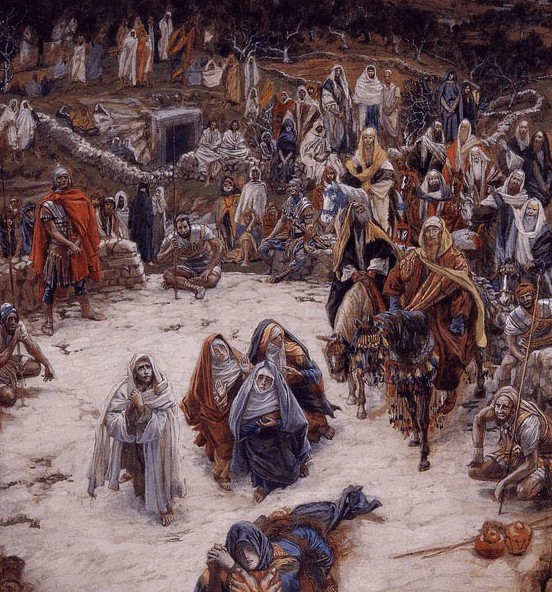
Most of what we know about Mary is because of her key role during Christ’s crucifixion and resurrection. We see her at the foot of the cross: ‘There were also many women there, looking on from a distance, who had followed Jesus from Galilee, ministering to him, among whom were Mary Magdalene and Mary the mother of James and Joseph and the mother of the sons of Zebedee’ (Matthew 27:55–56).
All the apostles except John had abandoned him and fled. Perhaps the women were more courageous; perhaps they recognised that they were less at risk of arrest than the men. They would have looked on in despair, unable to do anything. But we should not underestimate the comfort and encouragement that they gave to their Lord, just by being there in those final hours of torture.
When he was dead, two secret disciples Joseph and Nicodemus emerged from the shadows and begged to have the body. They took it away and laid it in a garden tomb. Mary Magdalene and another Mary followed them, and noted the location (Mark 15:47).
Having served their Lord faithfully in life, the women were now determined to perform their last devotion to his body—the Jewish anointing ritual. It was the Sabbath and they were not able to perform the ritual at the time, so they spent the day making preparations. Then when the Sabbath was over, in the first dim light of dawn, they returned to the tomb.
Sunday Morning
The events of the resurrection are related from four different angles in the four Gospel records. They contain apparent discrepancies, but these are generally viewed by historians as typical of eyewitness testimony—different people focusing on different highlights of an emotionally charged event. So this seems to be what happened:
In the dull first light of Sunday morning Mary led a small group of women (Luke 24:1), gingerly retracing their steps towards the place where they’d seen the Lord’s body laid (Mark 16:1–2). Perhaps their fear was heightened by a sharp tremor in the earth as they approached (Matthew 28:2).
They were unaware that a guard of soldiers had been set at the tomb. Before they arrived, the guard was dispersed by an angel who descended from heaven and rolled the stone away from the tomb’s mouth (vs. 3–4, 11–15).
They had been discussing how they could remove the great stone they’d witnessed being rolled against the tomb’s entrance (Mark 16:3), but when they arrived they found the stone had already been moved.
Mary Magdalene, assuming that the grave had been robbed, turned and ran to find her fellow disciples (John 20:2).
Meanwhile, the angel who had scattered the guards was now inside the tomb (Mark 16:5), with another angel (Luke 24:4). The remaining women entered the tomb and were shocked to see them. One of the angels spoke: “Do not be afraid, for I know that you seek Jesus who was crucified. He is not here, for he has risen, as he said. Come, see the place where he lay. Then go quickly and tell his disciples that he has risen from the dead” (Matthew 28:5–7). The women ran from the tomb to tell the apostles, who did not believe them (Luke 24:9–12).
The Women’s Witness

There is perhaps more to this command of the angel than we might recognise. In Jewish society at the time, men were important and women, generally, were not. If we don’t appreciate this, we don’t notice how radical Jesus was, in the way he treated women with respect and talked freely to them (for example John 4:1–26).
In Jewish society, a woman was not regarded as a reliable witness. Women could not testify in court. Perhaps the angels’ command to the women was a direct challenge to the apostles that they needed to overcome this cultural prejudice.
One of the reasons the new religion of Christianity was regarded with such suspicion in the First Century was its attitude to women. It’s obvious that men and women had different roles in the early church, but they had equal value (Galatians 3:28). This was revolutionary.
Reunited
When Mary Magadalene arrived with the news of the empty tomb, and presumably before the arrival of the other women, Peter and John ran to the garden to investigate (John 20:3–10). They found the tomb empty, and left.
Mary had followed them. She was not aware of what the other women had seen. Left alone and distraught, she stood outside the tomb weeping (v. 11). She stooped to look into the tomb—and there were the angels. They had not shown themselves to the men, but now they appeared again.

‘They said to her, “Woman, why are you weeping?”’ (v. 13). What kind of question was that? They knew that Jesus himself was standing behind her, and they must have watched with intense pleasure the encounter that followed.
‘She said to them, “They have taken away my Lord, and I do not know where they have laid him.” Having said this, she turned round and saw Jesus standing, but she did not know that it was Jesus. Jesus said to her, “Woman, why are you weeping? Whom are you seeking?” Supposing him to be the gardener, she said to him, “Sir, if you have carried him away, tell me where you have laid him, and I will take him away.” Jesus said to her, “Mary.” She turned and said to him in Aramaic, “Rabboni!” (which means Teacher)’ (vs. 13–16).
Can you imagine the passion in that exclamation! Her instinct, of course, would have been to fling herself at him and crush him in a sobbing embrace. Her nightmare had been turned into delirious joy.
But ‘Jesus said to her, “Do not cling to me, for I have not yet ascended to the Father; but go to my brothers and say to them, ‘I am ascending to my Father and your Father, to my God and your God’” (v. 17).
What exactly did he mean? He was not going to stay. He knew that after 40 days he would ascend to heaven to his Father’s side (Acts 1:9). But he was not going yet—there would be time to say all that needed to be said.
The Marriage
There’s more to it. That word ‘cling’ has connotations in the Bible. The Hebrew word means ‘fasten’. You may be reminded of another episode in another garden, when God created Eve as a wife for Adam:
‘And the rib that the LORD God had taken from the man he made into a woman and brought her to the man. Then the man said, “This at last is bone of my bones and flesh of my flesh; she shall be called Woman, because she was taken out of Man.” Therefore a man shall leave his father and his mother and hold fast to his wife, and they shall become one flesh’ (Genesis 2:22–24).

There was profound significance in this, the first appearance of the risen Christ. It was to his beloved disciple, Mary.
Jesus always said that he must go away, and come again (Mark 8:38). He compared his second coming to a wedding (Matthew 22:1–14). The Bible paints the beautiful picture of Jesus as the bridegroom, and the community of believers as his bride (Revelation 19:7–8). If you are a baptised believer, whether you’re a man or a woman, you are part of Christ’s bride. For now, we and he are ‘betrothed’—promised to each other, longing to come together. When he returns, Mary, along with all those others through the ages who have shared her love and devotion and promised themselves to him, will at last be united together.
KATIE CABEIRA