


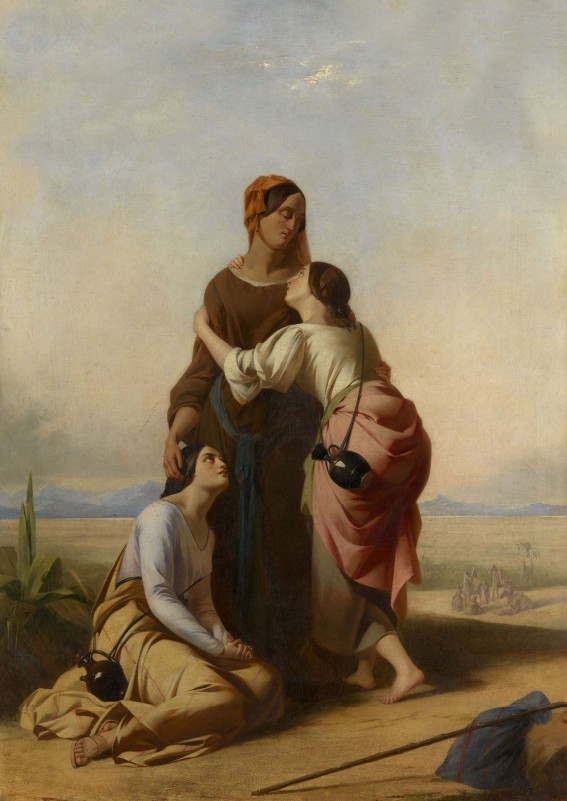
Ruth. Part two.
Naomi had lost her husband, her sons and her place in the Promised Land. But she still had two daughters-in-law, Ruth and Orpah. Although she had lost everything in human terms, she had not lost her faith in God, and her belief that He was in control. We see this in her speeches throughout the book, and in this she is like another Old Testament character, Job, who suffered terribly but trusted God (read Job 1:20-22, 2:9-10). Both of them would eventually be blessed richly by God.
Time to Go Back
Naomi heard that the famine was over in Israel, that God had visited His people to give them food
(Ruth 1:6). So she decided to return, for she knew that her hope was in God, in His promises, in His land. This is clear from the discussions that follow, as she recognises that God’s sovereign will is at work and her future does not lie in recreating her family in Moab.
It’s a helpful thought—how do we react when we have made a bad choice in our life? We might carry on regardless because we are too proud to admit we are wrong, or blame everyone else, even God! How much better to follow Naomi’s example and recognise where we were wrong, change our ways and act to improve the situation and get closer to God. Like the lost son in Jesus’ parable (Luke 15:11–32), we will find that God is a loving, forgiving father Who is waiting for us to turn to Him, and will accept us with joy when we do.
Naomi acted—she got up, packed her things and set off—her daughters-in-law with her. It reflects well on all of them that they had this close relationship, and Ruth and Orpah had not already gone back to their families. They were clearly attached to Naomi.
“Please Turn Back”
Despite this, Naomi pleaded twice with them that they would go back to their families and stay in Moab. Maybe she didn’t want them really to turn back but was doing what she thought was best for them. It would be very hard being a Moabite in Israel, with no family for sustenance or protection, with a new way of life and a new religion.
‘Naomi said to her two daughters-in-law, “Go, return each of you to her mother’s house. May the Lord deal kindly with you, as you have dealt with the dead and with me. The Lord grant that you may find rest, each of you in the house of her husband!” Then she kissed them, and they lifted up their voices and wept’
(Ruth 1:8–9).
At that time, the mother’s house would be the appropriate place for an unmarried woman. Note that Naomi uses the formal name of God (‘Yahweh’, generally written as Lord in the English Bible), emphasising the uniqueness of the God of Israel.
At first, both Ruth and Orpah refused to leave her: “No, we will return with you to your people” (v. 10). It’s a very loving, honourable, and emotional response, but there was no mention of God or His Promises.
The second plea comes next, in vs. 11–14. Naomi’s tone is tender but firm. She didn’t have any other sons for them to marry, and even if she had more babies, the young widows wouldn’t wait for them to grow up. Naomi here is alluding to a provision in the Law of Moses, sometimes called ‘levirate marriage’. The instructions are in Deuteronomy 25:5–10: if a man married but died childless, then the nearest eligible male family member should marry the widow. The firstborn son of that union would be named as the dead man’s offspring to continue his family line and his inheritance. This is important in the developing story of Ruth.
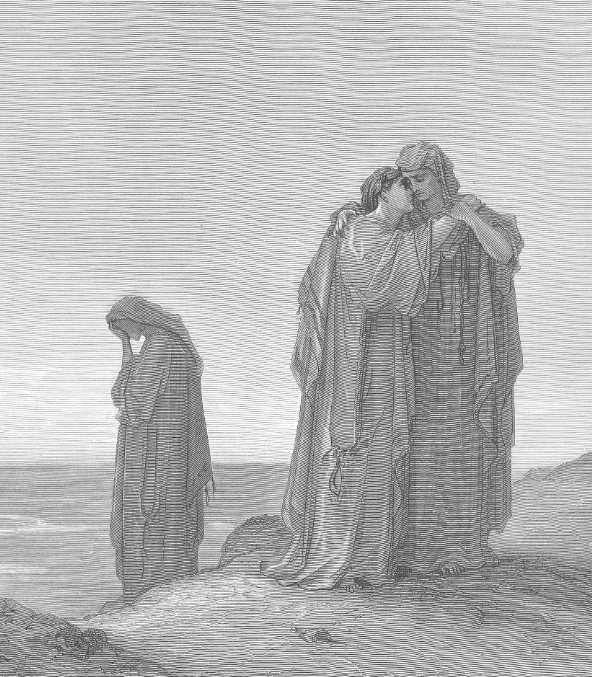
This time Orpah (one meaning of her name is ‘back of the neck’) left and returned to Moab. But Ruth was different.
Ruth Goes with Naomi
Verse 14 is a turning point, and we read that Ruth stayed, and held tight to Naomi. It’s a strong expression and reflects how tightly a husband and wife should hold on to each other. Naomi tried one last time to send Ruth back, reminding her of her Moabite heritage, her Moabite family, her Moabite religion. But Ruth had made up her mind.
Ruth’s response in vs. 16–17 is quite wonderful and has given joy to many, even being used in wedding services. It’s the commitment of a true believer: “Do not urge me to leave you or to return from following you. For where you go I will go, and where you lodge I will lodge. Your people shall be my people, and your God my God. Where you die I will die, and there will I be buried. May the Lord do so to me and more also if anything but death parts me from you” Ruth 1:16–17.
“My decision is made; I am committed to you; I will follow your example as well as your footsteps; I want to go in the same direction as you.” She wanted to live where Naomi lived and embrace God’s people of promise as her people. She recognised that salvation is with the God of Israel, and used Hebrew names for God, which Naomi must have taught her. When she said that she would die where Naomi died, she was making this allegiance for the whole of her life.
She was leaving behind everything from Moab—her home, her family, any future children, and her financial security. She was putting her confidence in the God of Israel and travelling to be among His people, in His land. She had learned from Naomi and been converted, had stated her faith and was putting that faith into action. That statement in vs. 16–17 is powerful, and perhaps one worth writing down and memorising, or putting somewhere where we see it often.
In a similar way, Jesus explained that following him may be difficult, as we turn our trust away from the things of this world, which are ultimately transient. It will cause a fracture in our lives, which he describes in
Matthew 10:34–39. But there is a great promise: “Seek first the kingdom of God and his righteousness, and all these things will be added to you’ (Matthew 6:33).
Ruth’s mind was made up, and she had said her piece. Naomi could see it, and they journeyed on together towards Bethlehem, and their destiny.
Arriving in the Promised Land
When Naomi and Ruth arrived in Bethlehem, the whole town was astir. The family were well known, probably they had been wealthy, and they all knew about their ill-fated journey to Moab. But what had happened, they asked? They barely recognised Naomi, with the ravages of time and the effects of tragedy and hardship, and she told them to call her Mara (which means ‘bitterness’) rather than Naomi (which means ‘pleasantness’) (Ruth 1:20).
She told them how God had witnessed against her and afflicted her, implying that she saw her sorry state as a punishment from God. The good news, she would find out, was that God was indeed in control, and would eventually make her story a happy one.
Naomi saw the hand of God at work and recognised that all the conditions of her life, good or bad, were not chance but came from God and for a reason. It’s another point for us to ponder—when we’re unsure of why things happen to us or why things don’t go to plan, we can trust that God knows best, and if we let Him, He will shape our lives and characters to bring us to His kingdom. Followers of God can have great confidence in this. Read Romans 8:18–39.
We are presented with Ruth as a young woman with no means of financial support, with no family other than Naomi, with no future in human terms; she had no natural right to be there at all, had no birthright to the promises and would be despised by the Israelites. She is even described as ‘Ruth the Moabite… who returned from the country of Moab’ (Ruth 1:22). For much of this story, Ruth would not be allowed to forget where she came from, and neither are we as readers.
But God had a wonderful future planned for Ruth, both then and eternally. She represents anyone who wants to be part of God’s family and share in His promises for the future. So Ruth’s story can be our story.
‘Remember that you were at that time separated from Christ, alienated from the commonwealth of Israel and strangers to the covenants of promise, having no hope and without God in the world. But now in Christ Jesus you who once were far off have been brought near by the blood of Christ’ (Ephesians 2:12–13).
ANDREW HALE
(to be continued)