



The story of Ruth the Moabitess is exquisite. It’s a tale of how God works to save people, and it is stripped of all unnecessary detail. With just 85 verses, you can read the whole book in 15 minutes—it’s a very good use of your time, perhaps before you follow this article.
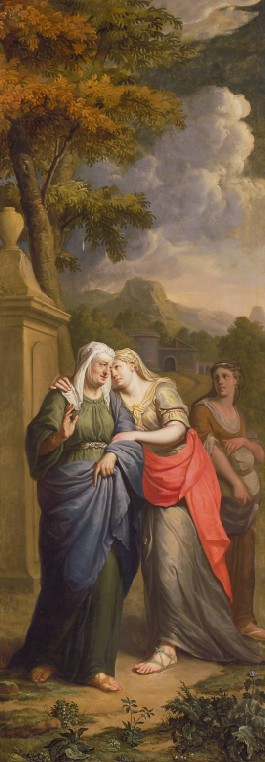
The narrative centres around two widows: Naomi is older and a Jew, Ruth is younger and a gentile. Both find themselves destitute, utterly vulnerable, and unable to save themselves. Yet, they are redeemed and brought into the family of God, given a home and cared for. ‘Redemption’, or being redeemed, is a key word—it means to be restored or ‘bought back’ and in its greatest sense is how God brings men and women back from sin and the sentence of death.
This story is also about ordinary people in a godless time of immorality and violence, who showed faith in God and love for one another. The central character, Ruth, exhibits great integrity, faith, and tenderness. She is called a virtuous or worthy woman (Ruth 3:11), and it’s worth reading Proverbs 31:10–31 to see how the Bible describes someone like this. Friendship and love are powerful themes in the relationships between Ruth and Naomi (her mother-in-law), and Ruth and Boaz (eventually her husband). They are practical examples of genuine affection, care, and serious commitment.
The book of Ruth is placed in the Bible after Judges, and before the books of Samuel which narrate the story of the first kings of Israel. Historically, the book of Ruth is significant as it bridges the period of the Judges to King David. In many older manuscripts, it appears as an appendix to Judges. The narrative provides background for the great King David, and so it is part of the story of Jesus’ family.
The Law of Moses also plays a role in the story, emphasizing that it is important to keep all of God’s commands, not just the ones we may particularly like. This includes provisions such as the right for the poor to collect the gleanings after harvest (Leviticus 19:9–10), and the law of ‘levirate’ marriage, in which a man marries his brother’s widow to have children and continue his name (Deuteronomy 25:5–10). The Law was not a dry theoretical concept, it was real and brought to life through the faith and love of people who observed it.
The power of God is another central theme, as He is shown to be in control at every stage. He takes Naomi and Ruth from a position of hopelessness and brings them into His family, to share the promises He made. The story of Ruth is a picture of how anyone can be brought into the family of God. There are strong echoes of the whole plan of God, the work of the Lord Jesus, and the redemption of His bride, the community of believers.
A Drama in a Deadly Time
The book of Ruth is organized into a four-act drama, well divided by its chapters. Pivotal moments include Ruth’s declaration of faith (chapter 1:16–17), when she meets Boaz in his field (2:8), Boaz’s declaration of commitment to Ruth (3:10–11), and the finale at the town gate (4:9–10).
The story is set in the time of the Judges, a time when the nation constantly failed to obey and honour God as king. The pattern of Israel’s behaviour at this time is described in Judges 2:11–19: they were repeatedly faithless and disobedient to God; He would punish them through invading neighbouring tribes; they cried out to God, Who would save them. However, they quickly reverted to their old ways, as summarised in the last verse of Judges: ‘Everyone did what was right in his own eyes’ (Judges 21:25).
The story of Ruth serves as a transition, showing how God would establish a righteous king in Israel, who would help people come to Him. In the first instance this would be David (Ruth’s great-grandson), and it will ultimately be fulfilled by Jesus, descendant of Ruth and David, and Son of God.
Famine and Disaster
The story starts in Ruth 1:1–5 with Elimelech, his wife Naomi, and their sons, who lived in Bethlehem in Israel. It seems that they were wealthy, as we later learn of possessions (probably a house and land) that they had left behind. There was a terrible famine, and ironically no food in Bethlehem (which means ‘House of Bread’ in Hebrew). They decided to travel to Moab, about 30 miles away to the east, which was seemingly unaffected by the famine. Maybe this tells us that the famine was one of God’s punishments on faithless Israel, or perhaps it was due to the complex geography and weather patterns of the area.
Moab was a tribe who were almost permanently at odds with Israel. During the Exodus, they opposed Israel (Numbers 22) and entrapped them in immoral behaviour (Numbers 25). We can see God’s view in Deuteronomy 23:3–6—Moabites were excluded from the congregation of Israel to the tenth generation. That’s a strong condemnation!
The family’s decision to go to Moab had disastrous effects, leading firstly to the death of Elimelech. After marrying Moabite women, Ruth and Orpah, his sons, Mahlon and Chilion died too. Ten years after coming to Moab, Naomi was left without husband or sons, but with two daughters-in-law. We do not know much about Elimelech, but it does look as though he deserted his people in a time of trouble. He disappears from the record at this point. Difficulties are a fact of life, small or big, personal or public. It is worth considering how we respond. The Bible shows us that the best approach is not to flee from a difficult situation, but to get closer to God, to seek His help and guidance. It isn’t always easy, but that is what Ruth would do, and she was well blessed by God.
Brighter Things to Come
So far, so miserable. However, in all this human weakness, we shall see that God is in control. He will bring Ruth into the family of Israel as a mother in the line of the Lord Jesus. Her name means ‘tender’ or ‘friend’, and she will be an example of love for others, faith, and responding to God’s goodness.
She represents anyone who wants to be free from the human condition of sin (disobedience to God) and its consequence, death. Ruth’s story is our story, a narrative of redemption, faith, and love that resonates through the ages.
ANDREW HALE
(to be continued)