


“You can’t go down there—it’s dangerous,” warned the official.
Jim protested, “I go there every week.”
“You should have had a letter from us warning that the whole site was going to be closed because of a fire hazard.”
“Oh!” Jim snarled, “I don’t read your junk mail.”
Warnings to the Jews
Years ago, not long before the Babylonian army took the kingdom of Judah into captivity, the faithful prophet Jeremiah warned the Jews about what would happen to them and to their land. His words were directly from Almighty God because of the nation’s wickedness. But their king Jehoiakim did not like the messages. Some of them were written in a scroll and read in the temple in Jerusalem. When the king heard the first part of the scroll for himself, he ignored the pleadings of his princes and cut up and burnt the scroll (Jeremiah 36:21–24).
Of course, destroying the written words could not invalidate the message of God and the captivity took place. Moreover, the king died and his body was unburied, just as Jeremiah had warned (Jeremiah 22:18–19, 36:30). Had he taken note, God would not have been so angry with him.
Bibles Burned
Other people have burnt God’s words. Hebrew Bibles were destroyed in the Spanish Inquisition in the 15th Century. In the 16th Century William Tyndale defied the authorities and set about translating the Bible into English. Many copies of his work were burnt, and eventually he himself was burnt at the stake. Ever since and even today there are those who despise and fear the Bible, and try to destroy it.
We might be horrified at such contempt for this special book. However, we need to ask ourselves how much we treasure the Word of God. Do we pick and choose the parts we read, and so deliberately ignore parts of God’s revelation to us? If so, we might just as well burn the other parts ourselves!
Bible Warnings
Do we value the actual words of the original Bible, as Jesus and the apostles did? The Bible, originally written in Hebrew and Greek, has now been translated into many languages. In languages like English there are also several different translations. However, the philosophy of translators does vary, and the quality of translations varies. Try to pick a translation that’s true to the original text. (A popular translation is the English Standard Version, which is used in the Glad Tidings magazine.) Do we pay attention to the details of the messages?
Jim burnt a letter but was restrained by an official who was looking after him. Without this he could have been in real trouble. Far more seriously, God’s message to us really is a matter of life and death. God warns of a day when Jesus will come back and judge the world (Acts 17:30–31). This will happen whether or not we have read about it, believed it or prepared for it. Do we really want to end up like king Jehoiakim?
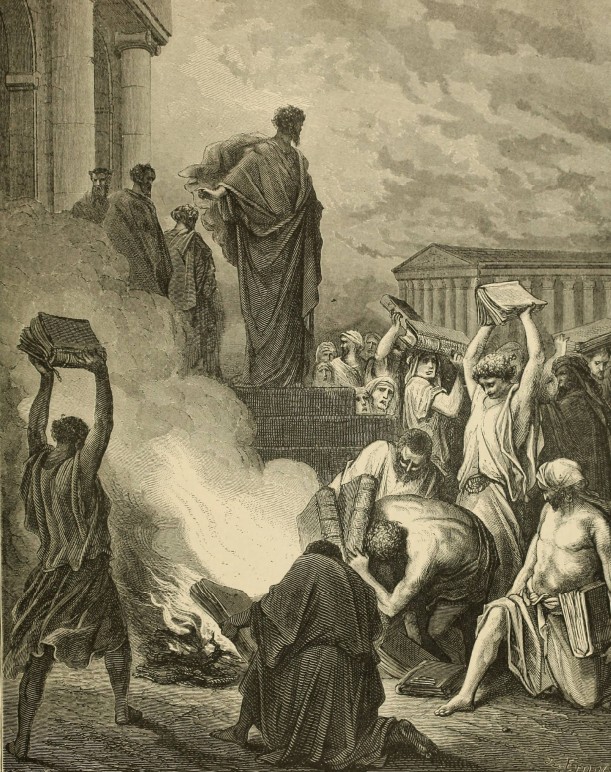
Some people have taken God’s message very seriously. In The Acts of the Apostles we read of converts to Christianity at Ephesus. They were enthusiastic for the hope of eternal life which was offered in the preaching of the apostle Paul. They burned the books associated with their ‘magic’—which were worth a fortune, thereby possibly destroying their livelihoods and even putting their own safety at risk (Acts 19:18–20, 23–40). Some have died for their faith. And the death of Jesus, for us, was an act of total obedience to the word of God.
Way of Escape
By ignoring the Bible we put our eternal wellbeing in jeopardy. When Jesus Christ returns there will be a judgement (2 Timothy 4:1). The extinction of those not found faithful is likened to an ever-burning fire from which there is no escape (Mark 9:43–48).
A common expression says that we should not ‘burn our bridges’: that is, we should not destroy our way of escape. Let us value God’s Word, which offers us true escape (2 Peter 2:20).
‘See that you do not refuse him who is speaking. For if they did not escape when they refused him who warned them on earth, much less will we escape if we reject him who warns from heaven’ (Hebrews 12:25).
ANNA HART