


‘The sum of your word is truth, and every one of your righteous rules endures for ever.’
(Psalm 119:160)
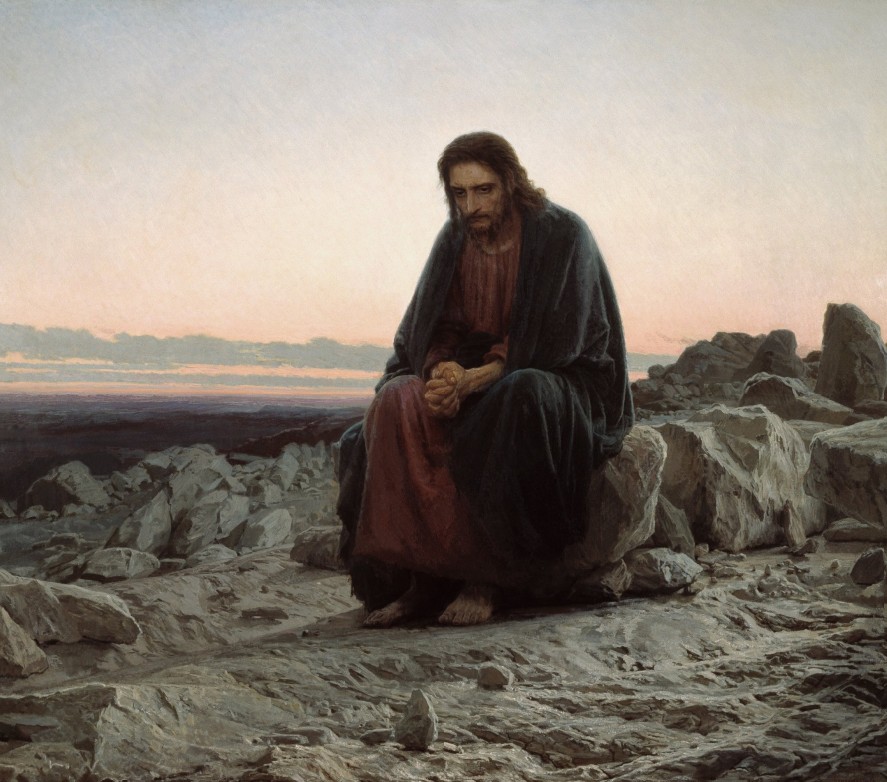
After his baptism Jesus was driven by God’s spirit into the wilderness in order to be tested (Matthew 4:1–2). He ate nothing for 40 days and nights, and it would be a time of agonising hunger.
In the gospel accounts, the temptations consisted of turning stones into bread, of taking all the kingdoms of the world, and proving he could be protected by angels if he jumped from a pinnacle of the temple. All were possibilities, but it must be clearly understood that these temptations did not take place in the physical world but in the heart and mind of Jesus. James tells us that ‘each person is tempted when he is lured and enticed by his own desire’ (James 1:14). Jesus was no exception. These three temptations were immensely powerful and assessed the strength of the Lord’s baptism vow and his commitment to the things of God. After all, his Father had just declared publicly that Jesus was his “beloved Son, with whom I am well pleased” (Matthew 3:17).
Christ’s temptations relate to basic human needs of survival and to pride. These are described elsewhere as ‘the desires of the flesh and the desires of the eyes and pride of life’ (1 John 2:16). They are not of the Father, but of the world, which will pass away.
How did Jesus deal with these temptations? He was a faithful Son, committed to his Father, and had embarked on a journey that would end with his death on the cross. Jesus’ responses to his temptations show us what the answer should be to all temptation, including our own. He did not make excuses or avoid the issues, but relied on scripture (the word of God) to control the matter and his own thoughts. This was a confrontation between the will of the flesh, and the Word and will of God.
It was Adam and Eve’s yielding to the will of the flesh in the beginning, that trapped all humanity in the morass of temptation and sin that we suffer from (Genesis 3). So, what did Jesus do? Because he knew in his heart what his Father wanted, he answered each temptation by his Father’s revealed Word by quoting the Bible, and through this means was able to resist the temptations. It was the only way.
Desires of the Flesh

When tempted to turn stones into bread, he said “Man shall not live by bread alone, but by every word that comes from the mouth of God” (Matthew 4:4). This was to become one of the infallible principles which would guide his life and provide the moral basis of his relationship with people. He was referring to Deuteronomy 8:3, which was originally addressed to the people of Israel as they were about to enter the Promised Land after their 40 year journey from Egypt. Moses was reminding them how they had been provided for throughout their long wanderings, and instructing them how to behave once they were in the Land, that they should not forget God but rather acknowledge Him in all their ways. This section of the Bible was written with Jesus in view—he was also the ‘son called out of Egypt’ (compare Hosea 11:1 and Matthew 2:13–15).
Pride of Life
The second test involved a fall from the highest pinnacle of the temple. The accuser this time referred to scripture from Psalm 91:11–12, but it was not quite accurate. This Old Testament passage reads, ‘He will command his angels concerning you to guard you in all your ways. On their hands they will bear you up, lest you strike your foot against a stone.’ But the tempter in the gospel record says, “If you are the Son of God, throw yourself down, for it is written, ’He will command his angels concerning you’, and ‘On their hands they will bear you up, lest you strike your foot against a stone’” (Matthew 4:6). It omits the important words ‘in all your ways’. This was crucial. The promise of God to protect Jesus was on the basis that he would be totally dedicated to observing and fulfilling his Father’s will and ways. The temptation was that Jesus should abandon this, put himself first and then test God, presuming on the promised protection even when he was being disobedient. Again, Jesus turned to the law at Deuteronomy 6:16 to thrust the temptation away: ‘You shall not put the LORD your God to the test.’
Desires of the Eyes
Then he was offered all the kingdoms of the world, if only he would worship the devil (that is, put himself forward). He replied, “Be gone, Satan! For it is written, ‘You shall worship the Lord your God and him only shall you serve’”

(Matthew 4:10). This refers to Deuteronomy 6:13. The context is an expansion of the first and second of the Ten Commandments, and the conduct expected by the nation when they were settled in the Promised Land. Jesus was aware that his fear and worship must be solely for his Father. He had been tempted to “worship” himself, as he was the king-designate of all he surveyed, but he knew that God alone must be worshipped. He conquered the trial.
We have looked at the temptations of Jesus and his answers from God’s Word. His answers were an act of worship. His whole life was one of worship, lived out in the daily round and the common task. He was a unique Son, with a singular mission—to call out a people for God, that they should be reconciled and prepared for eternal salvation. Jesus yielded to this purpose, for God’s Name must be honoured and magnified whatever the personal cost.
Jesus’ life was a perfect act of worship. Our lives and obedience should also be acts of worship, even though they will be imperfect (Mark 12:33).
Worship is a living entity. It is shown in the way we respond to the commandments and the Word of God. It is more than just respect for what God has said. It embraces love and devotion to Him and His ways and purpose. Worship is the giving of self to the will of God as much as we can, to please our loving God.
VIC AUCOTT (to be continued)