



There’s a baffling feature in the history of the early Israelites: the sudden appearance in the book of Judges of a bizarre array of apparently homemade implements of war, which is a stark contrast to the more conventional weapons which we see in their earlier history (for example Joshua 1:14, Joshua 6:9, 21, Judges 1:8). These curious instruments occur in the Bible record with no explanation as to why. Yet, a closer look explains all.
Failure and Subjugation
Israel’s capture of the Promised Land after their escape from Egypt is related in the book of Joshua. Although a success, it was not entirely so and Israel frequently found themselves engaged in battle, particularly with the fierce Philistines, occupants of the Mediterranean coastlands, who gradually gained the upper hand.
So, the first clue that something unusual was afoot comes when we find an Israelite named Shamgar killing 600 Philistines, not with sword or spear, but an ox goad—an agricultural tool used to prod working animals such as oxen and cattle. Another Israelite, Samson, was attacked by a lion. ‘Then the Spirit of the Lord rushed upon him, and although he had nothing in his hand, he tore the lion in pieces as one tears a young goat’ (Judges 14:5–6).
On another occasion this same man killed a thousand men with the jawbone of a donkey (Judges 15:15). Clearly daggers, swords and similar instruments were in short supply for the Israelites at that time.
Even after this era of the Judges in the reign of the first king, Saul, the same arms-shortage is evident. The shepherd boy, David, killed the giant Goliath with a pebble and sling, the only form of combat he knew
(1 Samuel 17:34–35, 38–40).
When David became a fugitive from King Saul he gathered fighting men around him. They appear to have been armed with bows and arrows and slings (1 Chronicles 12:2). There is no mention of swords or spears.
Once, when king Saul went into battle, we’re told that only he and his son (out of the whole Israelite army) possessed swords (1 Samuel 13:22).
So what is going on? How is it that this once-invincible, well-armed people were now resorting to home-made weapons—jawbones, slings, bows, arrows and ox goads—to defend themselves?
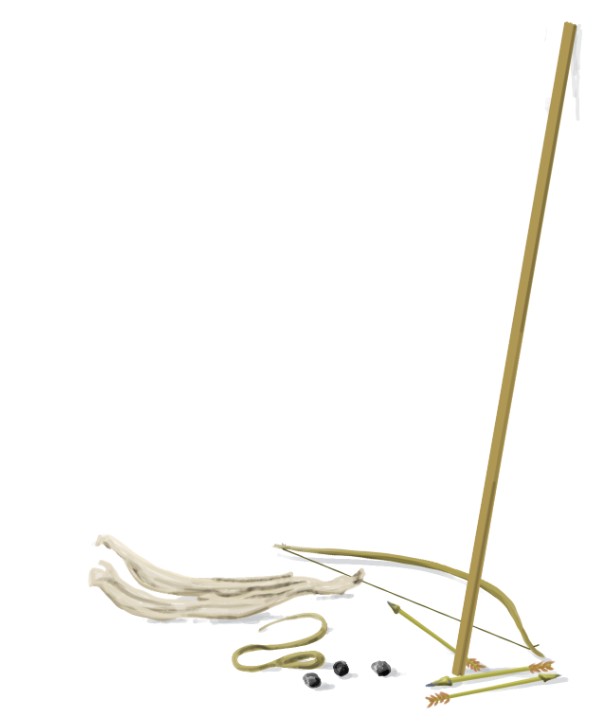
The Explanation
The answer comes in two simple verses:
‘Now there was no blacksmith to be found throughout all the land of Israel, for the Philistines said, “Lest the Hebrews make themselves swords or spears.” But every one of the Israelites went down to the Philistines to sharpen his ploughshare, his mattock, his axe, or his sickle’ (1 Samuel 13:19–20).
So, the dominant Philistines had introduced a law that prohibited the Israelites from owning any metal workshops. They were forced to pay Philistine blacksmiths to sharpen their agricultural implements for them. This kept the Philistines in overall control of both the Israelites’ agricultural life and their ability to defend themselves.
It is fascinating that the Bible only mentions this Philistine ‘law’ once and doesn’t expand or elaborate on the life-changing effect it had on the people living under it.
The examples highlighted show how something unusual was happening, that the subjugated people were forced to get inventive to circumvent this prohibition on their everyday lives. When we consider the impact of the injunction, we understand what lies behind the (sometimes) peculiar weapons the Israelites used. But at no point does God’s word spell it out; we must notice it for ourselves. It’s another little detail that shows how reliable and accurate the Bible is (and how vital it is to notice the details)!
JOAN LEWIS
Adapted from Undesigned Scriptural Coincidences by J J Blunt.