


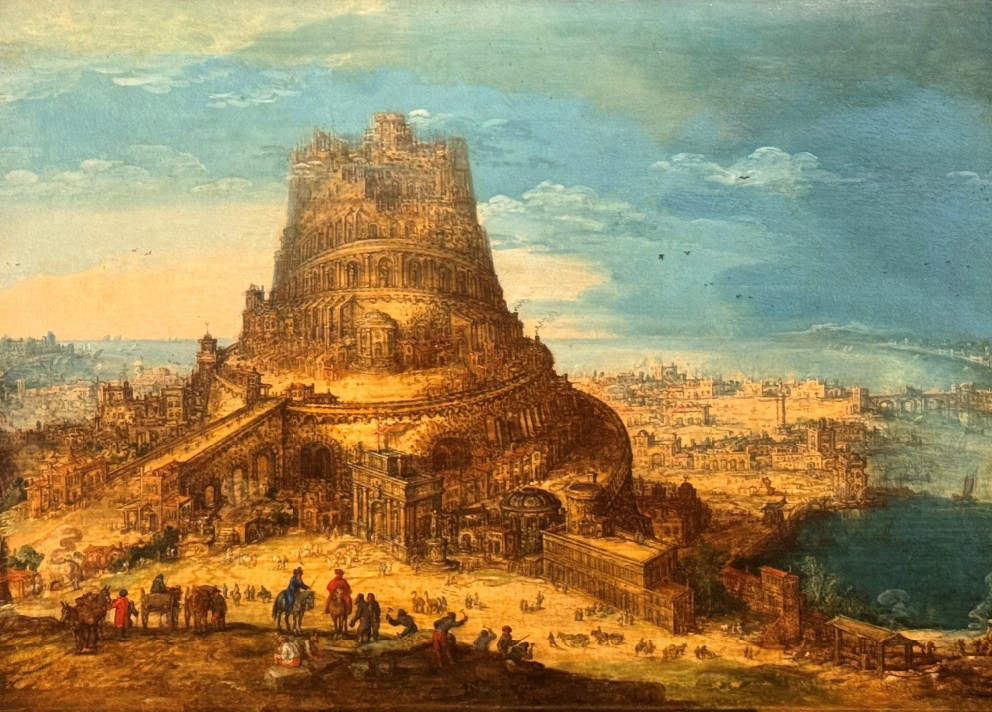
Genesis 11 contains the account of the tower of Babel. After Noah’s Flood, the world’s population settled in a plain and set about a building project: “Come, let us build ourselves a city and a tower with its top in the heavens, and let us make a name for ourselves” (v. 4).
God’s response was to confuse their languages and disperse them over the face of the earth (v. 9).
Babel was more than a tower. It was also the prototype of every political system whose builders put their trust in their own technical achievements instead of God. When rulers plan titanic schemes but leave God out of their reckoning, the result will always be division, confusion and dissolution, because that is God’s response to humanity’s every attempt to be their own god and decide their own destiny: ‘Unless the Lord builds the house, those who build it labour in vain’ (Psalm 127:1).
Babel fell into ruin, but its proud spirit lived on in the empires of Babylon, Greece and Rome and all other political and economic systems that have exalted themselves against God. It lives on today in the ideologies and utopian programmes that have promised a bright new order of universal peace, prosperity and unity: Communism, the United Nations, the European Union—all begin with optimistic predictions about the wonderful future that will be realized once the project reaches fruition. It lives on in the ambition to conquer space and build colonies on the moon and on Mars. All empires and political systems have in effect declared, “Come, let us build ourselves a city and a tower with its top in the heavens”.
In his vision of the establishment of the Kingdom of God, the prophet John saw two cities: Babylon the Great, which symbolises the nations of this present world, and New Jerusalem, which symbolises God’s Kingdom. Babylon is overthrown, with echoes of Genesis 11: “So will Babylon the great city be thrown down with violence, and will be found no more” (Revelation 18:21).
In contrast, John then sees the city of God—the opposite mirror image of Babylon. ‘Then I saw a new heaven and a new earth, for the first heaven and the first earth had passed away, and the sea was no more. And I saw the holy city, new Jerusalem, coming down out of heaven from God, prepared as a bride adorned for her husband’ (21:1–2).
Babylon was built by people with the intention of exalting themselves to heaven. In contrast, New Jerusalem comes down out of heaven, to be set up on earth, a city that will not be destroyed but will stand for ever and ever, because it is ‘the city that has foundations, whose designer and builder is God’ (Hebrews 11:10).
PAUL WASSON