


At last, to Jacob’s great relief, Laban bade him a grudging farewell, and left him alone with his family (Genesis 31:55). But his troubles were not over—rather, they were about to begin. The next obstacle he had to face was the temper of his brother Esau, who had been planning to kill him when he left home all those years ago (Genesis 27:42).
Jacob sent messengers ahead to inform his twin that he was on the way, and meanwhile continued slowly southwards. To his consternation, his servants returned with the news that Esau was coming to meet him, with four hundred men (32:6). Jacob immediately feared the worst. Undoubtedly, he argued, Esau was bent on revenge—he must have been nursing his anger all these years, and would soon be upon them, tearing Jacob’s little band into pieces in a bloody slaughter.
His reaction in this emergency is instructive. He had no weapons or skill in fighting to defend himself against his warlike brother. There were only two things left he could do. The first he put into effect that very night. He got down on his knees and begged God to deliver him from his brother. He reminded God that He had promised to make of him a great nation, a promise that could not come true if his family was wiped out. God’s word was staked on his survival. But he asked it very humbly, in a monumental prayer.
O God of my father Abraham and God of my father Isaac, O LORD who said to me, ‘Return to your country and to your kindred, that I may do you good,’ I am not worthy of the least of all the deeds of steadfast love and all the faithfulness that you have shown to your servant, for with only my staff I crossed this Jordan, and now I have become two camps. Please deliver me from the hand of my brother, from the hand of Esau, for I fear him, that he may come and attack me, the mothers with the children. But you said, ‘I will surely do you good, and make your offspring as the sand of the sea, which cannot be numbered for multitude’” (32:9-12).
Jacob made plain his helplessness, his fear, his unworthiness, and left the outcome to God.
The other course of action Jacob settled on was both ingenious and practical. He sent on ahead an enormous present for Esau, to appease his wrath. This combination of prayer and sensible precaution is repeated many times in the Bible’s biographies, and illustrates the point that we cannot simply leave it to God and do nothing ourselves every time we are in trouble. There will be times when we really are helpless, with no options but prayer alone. But when there is something practical that will help forward our case, there is no virtue in neglecting it. Goliath, for example, did not fall by a thunderbolt, but by a well guided stone from a faithful shepherd’s sling (1 Samuel 17:49).
Later that night Jacob met an angel in the darkness, sent to protect him (Genesis 32:22–32). Assuming he was an enemy, he wrestled with him. Only at daybreak did the angel break free and inform Jacob that God was going to change his name. He would no longer be Jacob, “the man who grabs by the heel’”. Now he would be Israel, “a prince with God”. But he was left with a permanent limp. It would remind him every day that God, not human cunning or wisdom, is our true strength.
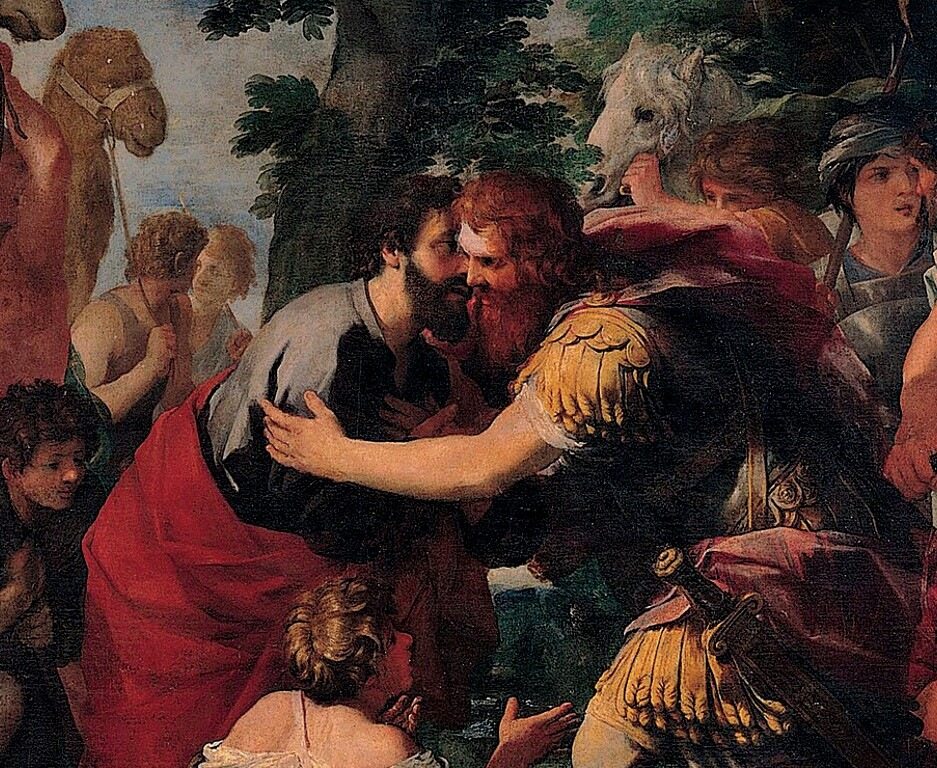
To Jacob’s great relief, Esau met him with a big hug, and after a brief exchange of news, the brothers parted on the best of terms (ch. 33). Jacob had crossed his second hurdle, with greatly increased faith, and resumed his pilgrimage to Bethel, the “House of God”.
DAVID PEARCE
(to be continued)