


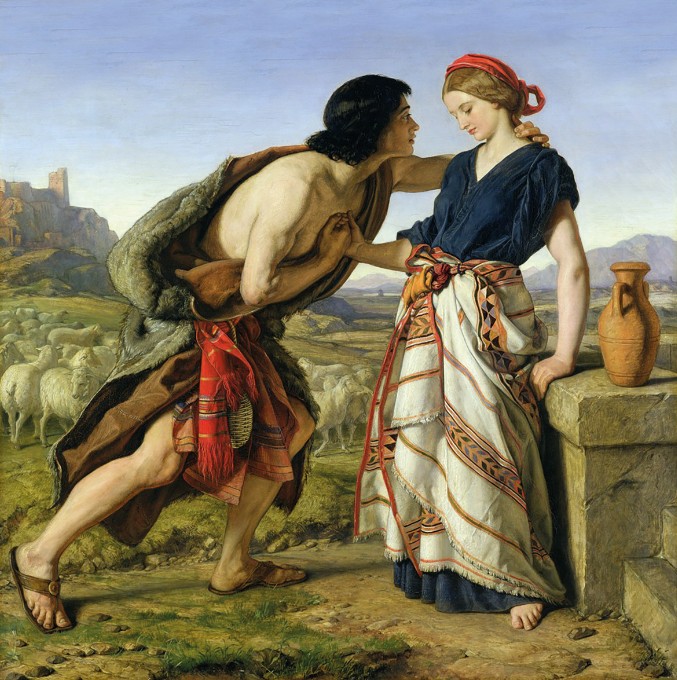
In real life, love at first sight is rare. But with Jacob, it was a classic case. He had just completed a 400-mile (600 km) pilgrimage to Haran, the city where his mother was born. Tired, lonely, but excited at the prospect of meeting his relatives for the first time, he stood near the public well waiting to ask someone the way to his uncle’s house. At that moment a beautiful shepherd girl approached, bringing her flock to be watered. At once Jacob sprang into action, rolling away the great stone that covered the well and filling up the troughs for her animals to drink. Before long he was deep in conversation with the blushing shepherdess, who, to their mutual surprise, turned out to be his cousin. He was escorted home, and introduced to the family, who were glad to hear news of their relatives down south. But Jacob had eyes only for Rachel, the girl he met at the well. The romance between them is one of the tenderest, and yet the most tragic, in the whole Bible story. It began with a courtship that lasted a daunting seven years, and left Jacob penniless.
Bride Price
How did this happen, you may wonder? In those days it was not just a case of informing your prospective father-in-law that you intended to marry his daughter. You had to pay a large sum of money up front before he would sign the contract. Jacob had no ready cash to provide a dowry for Rachel, and his father and mother were too far away to help him out. So he agreed to work for his uncle, with no wages except his board and lodging, to pay for his bride. “I will serve you seven years for your younger daughter Rachel,” he said. Laban replied, “It is better that I give her to you than that I should give her to any other man; stay with me” (Genesis 29:18–19).
Consider what Jacob agreed to pay for his marriage. What would seven years’ wages amount to for a skilled shepherd such as him? And to wait seven whole years was a test in itself. Yet his love never faltered: ‘Jacob served seven years for Rachel, and they seemed to him but a few days because of the love he had for her’ (v. 20).
Laban was a hard master, and a rogue. When the contract expired, he gave Jacob his wife. But he insisted he must also marry Leah, his elder daughter, because the etiquette of his country demanded that the eldest daughter should marry before her sisters. Jacob found himself working another seven years, again for no pay. At the end of that time he signed on for a further period, to be paid in kind out of the annual crop of lambs and kids which were in his care. At last, he began to acquire some wealth of his own.
Even then the rascally Laban kept changing the conditions of the agreement, to cheat Jacob of his due. Sometimes this year’s white lambs were to be Jacob’s, but when Laban found there were more white ones than black, he changed the rules. But God saw to it that Jacob prospered, and his uncle grew poorer and poorer.
Time to Leave
Eventually, after 20 years with his uncle, Jacob had had enough. He now had children born of his two wives and their two maidservants. His capital in the form of livestock and servants was respectable. It was time to leave. While he was thinking along these lines, he had another dream. He saw the angel of God, who reminded him that He had faithfully kept His promise to preserve and feed him all these years. He must now go back to his native land. “I am the God of Bethel, where you anointed a pillar and made a vow to me. Now arise, go out from this land and return to the land of your kindred,” he said (Genesis 31:13). So Jacob gathered his possessions together, waited till Laban was away on a sheep-shearing trip, and stole away southwards.
Predictably, Laban came chasing after his son-in-law, angry that he had slipped away without giving notice. In the confrontation that followed, Jacob reminded him what a miserly employer he had been. “There I was,” he recounted: “by day the heat consumed me, and the cold by night, and my sleep fled from my eyes… I served you for fourteen years for your two daughters, and six years for your flock, and you have changed my wages ten times” (Genesis 31:40–41). Laban had no cause for complaint at all.
Working for God
This attitude of Jacob towards an unfair and harsh employer is worth considering in the context of modern employment protection and trade unions. You would have thought Jacob would have been justified in
walking out on his master when he was treated so badly (at least, after he had finished paying for his first wife!). But he stuck it out, and continued to give faithful service. Jacob’s dedication is a fine example of the conduct the Apostle Peter recommends in the New Testament for the Christian disciple. ‘Servants, be subject to your masters with all respect,’ he insists, ‘not only to the good and gentle but also to the unjust. For this is a gracious thing, when, mindful of God, one endures sorrows while suffering unjustly… if when you do good and suffer for it you endure, this is a gracious thing in the sight of God’ (1 Peter 2:18, 20). ‘Gracious in the sight of God’ is the key. The Christian should serve their employer as if they were working for God. Nothing less will do. We are not permitted to slacken our effort because our employer is unreasonable. That would be returning evil for evil. God sees and weighs our lives, and will reward us with the measure that we give.
As Jacob’s case illustrates perfectly, God is able to ensure that we do not lose out. In the last analysis, Jacob ended up richer than his employer. The Apostle Paul puts it perfectly: ‘Whatever you do, work heartily, as for the Lord and not for men, knowing that from the Lord you will receive the inheritance as your reward. You are serving the Lord Christ’ (Colossians 3:23–24). It may seem strange to be receiving lessons in labour relations from the book of Genesis, but there is no doubt where the Christian’s duty lies. Old Testament and New Testament speak with one voice on this important principle.

David Pearce
To be continued.