



I picked up a booklet. It was a funky design and had lots of pictures. It took a couple of minutes to read—it told me about God, and how we are sinners, and how God sent His Son to save us from our sins. On the last page it invited me to be saved by saying this prayer:
Heavenly Father,
I’m sorry that I’ve messed up. Thank You for sending Jesus to die for me, paying off all my sins. Thank You for raising Him from the dead. Father, please accept me as Your child and reveal Yourself to me. Forgive me for all my sins. I want to make Your Son, Jesus, the Lord of my life. Help me to follow His commands, and please give me eternal life to live with You forever. Thank You Father for the promise of a new life with You.
In the name of Jesus, I pray, amen.
Intrigued, I did a bit of research. There doesn’t seem to be any hard data, but evidence suggests that when people are “saved” by responding to an invitation like this, there is an extremely high probability that very soon they will forget about it and their lives will go on as before.
When you think about it, this might mean one of three things:
1. God’s method of saving people is not very effective; or
2. God really doesn’t mind if, having been converted, people turn their back on Him; or
3. this is actually not the right way to become a Christian.
When you look into the Bible, it’s clear that number 3 is the correct answer.
Jesus Christ told people what they must do to be saved. ‘The time is fulfilled, and the kingdom of God is at hand; repent and believe in the gospel’ (Mark 1:15). They needed to understand and believe the Gospel (that means the “good news”), and respond by repentance—that means acknowledging that you’ve been going wrong, and turning around.
Being Born Again
This change of heart must be marked by action. Jesus said again, ‘Truly, truly, I say to you, unless one is born of water and the Spirit, he cannot enter the kingdom of God’ (John 3:5). To be ‘born of the Spirit’ means opening your heart to God’s spirit and allowing it to transform your life, by means of His word the Bible (John 4:24, 6:63, Romans 8:1). To be born of water is baptism—a simple ceremony in which you are fully immersed in water. As Jesus commanded his disciples, ‘Go into all the world and proclaim the gospel to the whole creation. Whoever believes and is baptized will be saved, but whoever does not believe will be condemned’ (Mark 16:15–16).
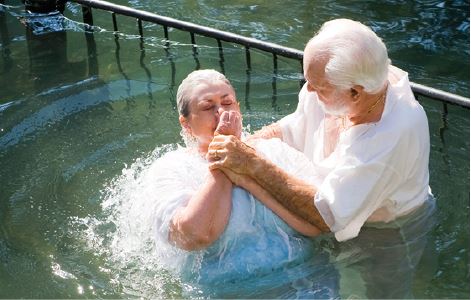
Baptism is a symbolic death and resurrection. It’s how we show that we want to “put to death” our old way of life, and rise to a new life in Christ. It’s how we align ourselves with him, who literally died and rose to life again to defeat sin. It’s explained by the Apostle Paul: ‘Do you not know that all of us who have been baptized into Christ Jesus were baptized into his death? We were buried therefore with him by baptism into death, in order that, just as Christ was raised from the dead by the glory of the Father, we too might walk in newness of life’
(Romans 6:3–4).
The Bible’s New Testament contains the account of the birth and growth of the Christian community. It started with John the Baptist and then Christ and his disciples baptising people in the River Jordan. The consistent picture is that whenever someone committed their lives to Christ, they were baptised (with the notable exception of the robber on the cross (Matthew 27:38), who was physically unable to do so).
Clearly, there’s very much more to becoming a Christian than reading a colourful booklet, or attending an emotionally charged evangelising event.
Falling Away
Those who publish these booklets and arrange these events are often motivated by the idea that when someone is “saved”, God will see to it they can no longer be lost. The idea is based on Bible passages such as this: ‘If you confess with your mouth that Jesus is Lord and believe in your heart that God raised him from the dead, you will be saved’ (Romans 10:9).
The facts indicate otherwise. Jesus himself lost one of his disciples (John 17:12). Paul was well aware of the risk that he might fall away (1 Corinthians 9:27). It’s a fact of life that people can lose their faith. It’s the more tragic, because of its seriousness. The Bible says that when someone turns away from their faith ‘they are crucifying once again the Son of God to their own harm and holding him up to contempt’ (Hebrews 6:6).
The Bible describes the wonderful privilege of being a follower of Christ in many different ways. For example, Christ himself said, ‘Truly, truly, I say to you, whoever hears my word and believes him who sent me has eternal life’ (John 5:24). But nowhere does it say that we cannot forfeit this privilege if we’re unfaithful.
To become a follower of Christ is momentous. It’s the most important decision you will ever make. Your baptism is the day that your life turns around, you become a child of God and from that time forward you are preparing for eternal life in His Kingdom. Paul described his new life like this: ‘I have been crucified with Christ. It is no longer I who live, but Christ who lives in me. And the life I now live in the flesh I live by faith in the Son of God, who loved me and gave himself for me’ (Galatians 2:20).
It goes without saying that this is a decision which needs to be approached carefully, thoughtfully and prayerfully.
Chris Parkin