


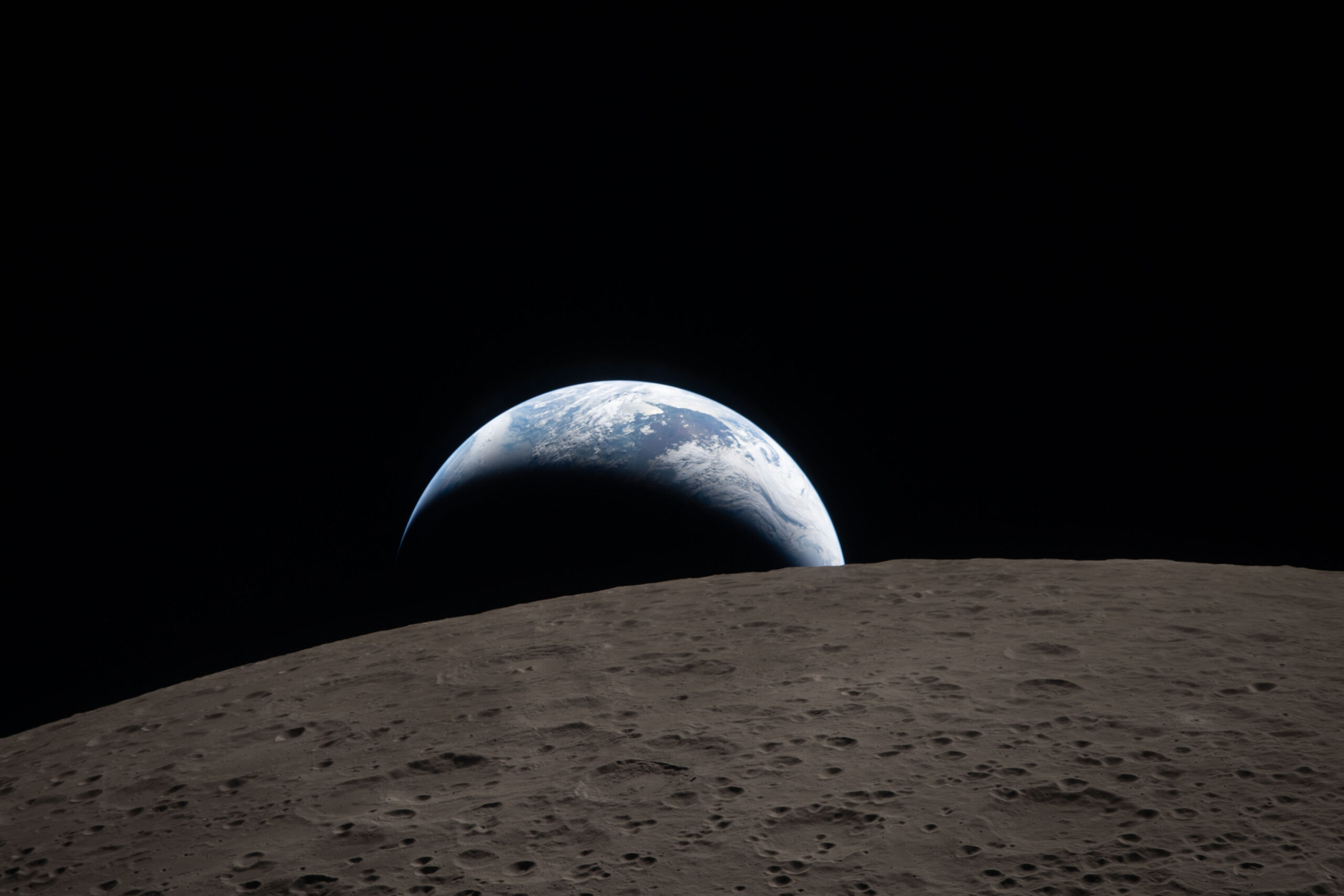
The story of Artemis II has been nothing short of remarkable, and through NASA’s media we’ve been able to enjoy the drama as it unfolded. Many of us across the world have watched in wonder as the crew flew around the moon: 248,655 miles from earth, further into space than any humans have been before. The pictures are spectacular – the earth ‘setting’ as seen from the lunar surface, the sun eclipsed by earth, detailed images of parts of the moon previously unseen by human eyes, and many beautiful pictures of the blue planet on which we live.
The science behind this mission is equally astounding, the technology that was able to get them there and back. And consider the unchanging laws of nature – of physics – on which all of these are built. Forces such as gravity and jet propulsion act predictably and consistently, and brilliant minds are able to calculate how spacecraft will behave hundreds of thousands of miles into space. Those laws did not happen by chance, neither did the intelligence to calculate with them.
As we consider the wonder and beauty of ‘the heavens’, it’s a great opportunity to keep thinking beyond the day-to-day. Theories about how the universe came into existence (such as the ‘Big Bang’) require a force which existed before and outside of it. The Bible tells us very clearly: ‘In the beginning, God created the heavens and the earth… and God made the two great lights—the greater light to rule the day and the lesser light to rule the night—and the stars’ (Genesis 1:1).
The sheer magnificence of this creation is a repeated theme throughout the Bible. It teaches us about the power of God, and also that He is unchanging and deeply interested in the men and women who live upon this earth.
‘When I look at your heavens, the work of your fingers, the moon and the stars, which you have set in place, what is man that you are mindful of him, and the son of man that you care for him?’ (Psalm 8:3-4).
‘[Give thanks] to him who made the great lights, for his steadfast love endures forever; the sun to rule over the day, for his steadfast love endures for ever; the moon and stars to rule over the night, for his steadfast love endures for ever’ (Psalm 136:7-9).
The Bible explains that the creation was designed to teach us specific things about God: ‘His invisible attributes, namely, his eternal power and divine nature, have been clearly perceived, ever since the creation of the world, in the things that have been made. So they are without excuse’ (Romans 1:20). Who are the ‘they’ here? It’s everyone who ever has lived, who has seen the sun, moon and stars, and experienced life on earth. If we fail to recognise that there is a God behind them, then we have no excuse.
However, there are things that looking at creation cannot teach us – and for these we turn to God’s Word, the Bible. Here we learn that God is kind, merciful and loving, as experienced by men and women through time and especially in the person of the Lord Jesus Christ. We also learn that God has a plan for the earth:
‘Thus says the Lord, who created the heavens (he is God!), who formed the earth and made it (he established it; he did not create it empty, he formed it to be inhabited!) … “For I am God, and there is no other. By myself I have sworn; from my mouth has gone out in righteousness a word that shall not return: To me every knee shall bow, every tongue shall swear allegiance”’ (Isaiah 45:18-23). See also Numbers 14:21, Psalm 72:19, Isaiah 11:9 and Habakkuk 2:14.
Jesus taught the same in his example prayer: “Your kingdom come, your will be done, on earth as it is in heaven” (Matthew 6:10).
Jesus will come back to set up this new order – the Kingdom of God. The earth will be cleansed of pollution and humankind’s mismanagement, made fertile everywhere to produce enough food for everyone, and ruled with justice for all. It will be inhabited for ever by people who worship God in freedom and peace. Read Psalm 72, Isaiah 2:1-5, Isaiah 11:1-9 and Isaiah 35 for a taste – then keep reading!
You can be there, if you respond to God’s invitation. Visit https://gladtidingsmagazine.org/.
As we enjoy the wonders of space exploration, let’s keep looking ‘above’, being mindful of the Creator. Let’s open our Bibles to learn about His marvellous message for our eternal future.
Andrew Hale